Geospatial Technology
Case Study #1 --- Utah's 7.0 Earthquake

|
Ground Shaking Map.pdf Size : 0.859 Kb Type : pdf |
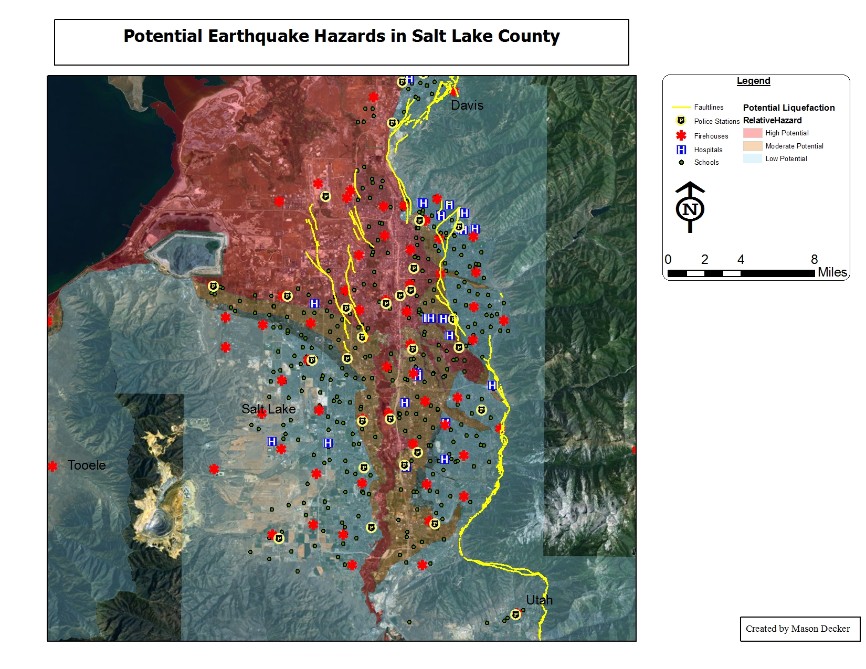
Question 1: What potential problems do you see in terms of the spatial distribution of hospitals, police stations, and fire stations in Salt Lake County, Utah compared to the fault lines and potential liquefaction zones? How about transportation networks? How would that affect emergency response crews?
While analyzing the maps I created and doing some research on the predicted magnitude 7.0 earthquake, I noticed that in Salt Lake County, Utah, a big majority of emergency services are located in the high potential liquefaction zones. In fact, nearly every hospital and police station in Salt Lake County is located in either a moderate or high potential liquefaction zone. This means that if the earthquake causes the damage that is expected, a lot of the hospitals, police stations, and fire stations will be badly damaged and even possibly destroyed. The problem with the spatial distribution of the emergency services is that most of them were built near fault lines, which is a big reason for the high potential of liquefaction.
A big problem I noticed with the transportation networks in Salt Lake County is that the major freeway (I-15) is located within a few miles of the Jordan River, which means it is in a high potential liquefaction zone. When the earthquake occurs, it will be very difficult for emergency response crews to drive from the low potential liquefaction zones to the more likely damaged high liquefaction zones because the main roads will be severely damaged.
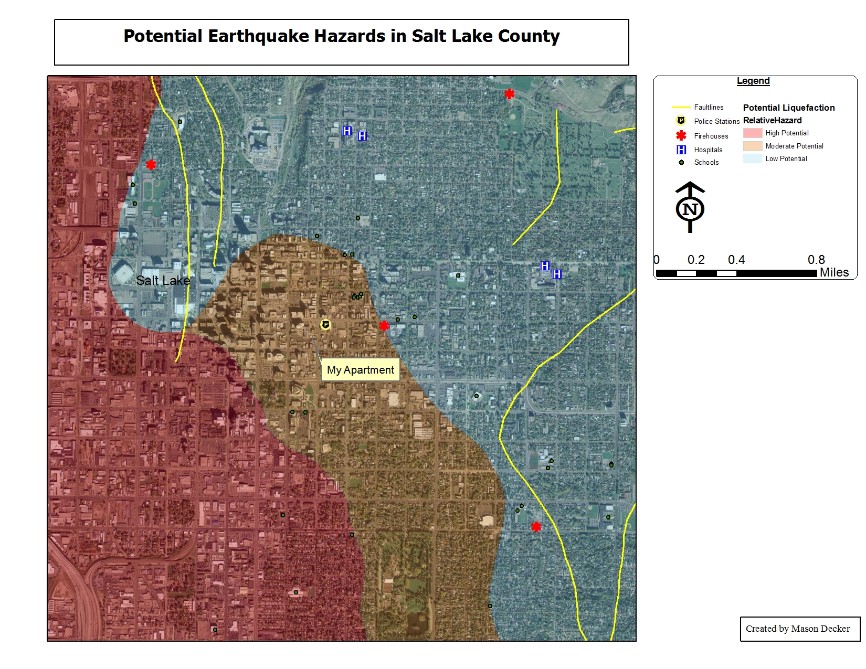
Question 2: How close do you live near a fault line and what liquefaction zone are you in? What potential hazards might you expect during or following an earthquake along the Wasatch Front.
I currently live in a moderate potential liquefaction zone, however I live within a half mile to the east of a fault line and high potential liquefaction zone. If the earthquake happens while I am at home, I will be in trouble. I live in downtown Salt Lake City in an area that is highly populated. A good thing is that I live near several hospitals, but unfortunately each of them is right next to a fault line and in a high potential liquefaction zone. Even if the hospitals that I live by aren’t severely damaged, they will most likely not have any room for me because there will be so many injured people.
After studying these maps and thinking about what a 7.0 magnitude earthquake might be like in Salt Lake County, I have decided that I need to prepare for it. I currently do not have any food storage or emergency equipment of any kind in my apartment. I need to put together a 72 hour kit and make plans for what I will do when the earthquake comes.
